Emergency Vehicle Towing vs Interstate Car Transport
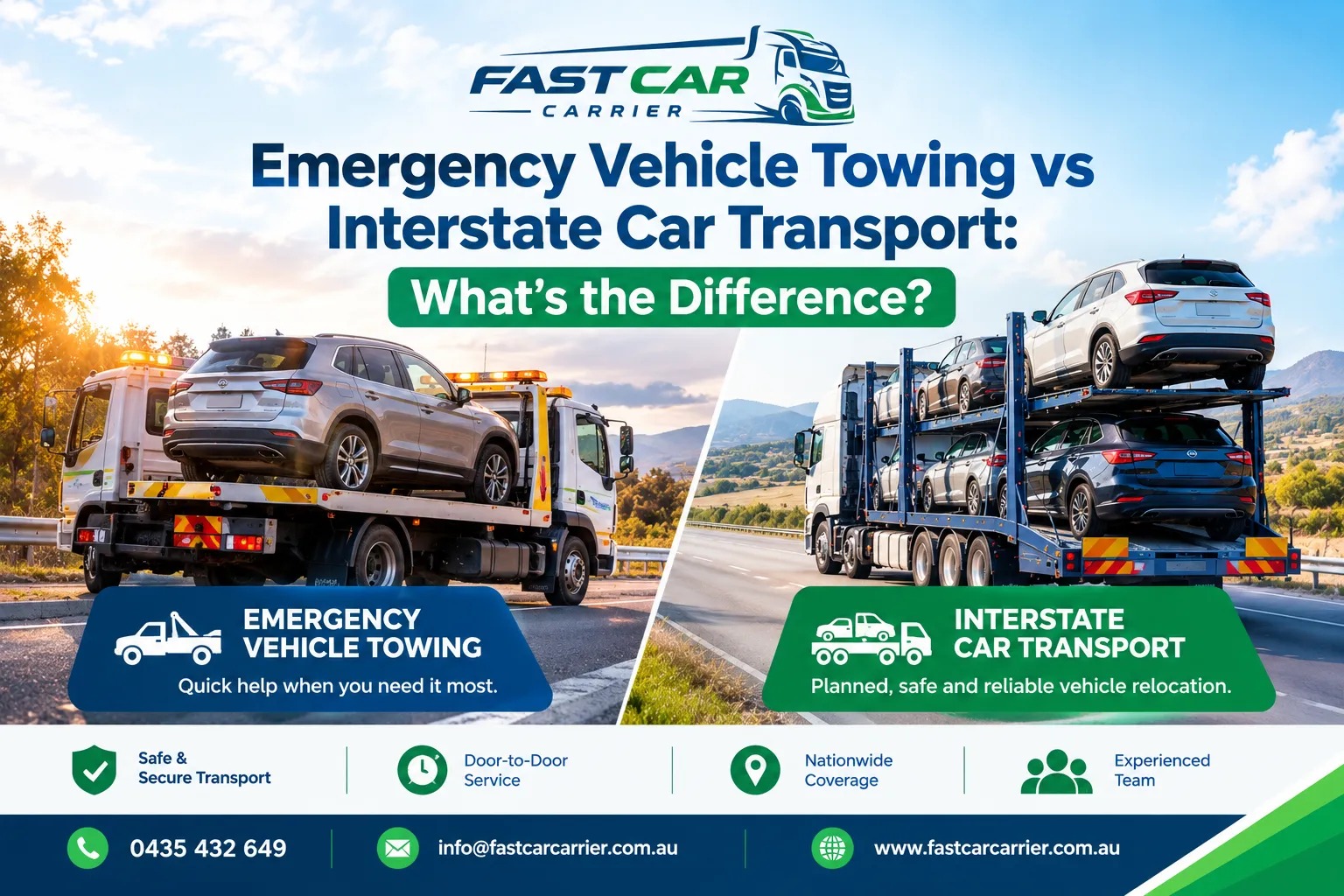
01-Oct-2026Emergency Vehicle Towing vs Interstate Car Transport: What's the Difference?
A car stops on a country highway. Another is damaged after a crash. A family is moving from Melbourne to Perth with two vehicles. A project car that won't start needs to reach a new owner in another state.
All four vehicles need to move. But they don't need the same service.
Many people use "towing" and "car transport" as if they mean the same thing. They don't. Towing deals with an urgent problem. Car transport is a planned move from one place to another.
This guide explains how the two services differ. It covers when to use each one, how non-running vehicles fit in, what affects cost and timing, and what to tell a transport company before you book.
What Is Emergency Vehicle Towing?
Emergency vehicle towing is about responding to an immediate vehicle problem. Something has gone wrong, and the vehicle can't safely continue.
Common situations include:
Roadside breakdowns
Engine failure
Battery-related problems
Overheating
Accidents
Disabled vehicles
Vehicles stuck in hard-to-reach spots
Vehicles that need recovery
The goal is simple. Get the vehicle and the people around it to a safe place. That might be a workshop, a repairer, or your home.
Fast Car Carrier's emergency vehicle towing service covers roadside towing, accident towing, breakdown towing, vehicle recovery, winching, and flatbed towing. These are all built around a problem that can't wait.
What Is Interstate Car Transport?
Interstate car transport is planned transport from one location to another. A car carrier moves the vehicle between cities or states, often over long distances.
People use it for many reasons:
Moving house or relocating for work
Buying or selling a car in another state
Sending a second family vehicle
Dealer and fleet vehicle movements
Moving a car that shouldn't be driven far
Nothing is broken down on the side of the road. There is a pickup, a route and a delivery.
Fast Car Carrier provides interstate car transport across Australia. Options include door-to-door, open and enclosed transport, express transport, and door-to-depot services.
Emergency Vehicle Towing vs Interstate Car Transport: A Quick Comparison
The table below shows the main differences. Real jobs vary, so treat it as a general guide.
Factor Emergency Vehicle Towing Interstate Car Transport
Main purpose Emergency recovery Planned vehicle relocation
Typical situation Breakdown or accident Interstate move or sale
Timing Urgent Usually scheduled
Distance Usually local or regional Long-distance, interstate
Vehicle condition Often disabled or damaged Running or non-running
Typical equipment Tow truck or flatbed Car carrier
Destination Workshop, home, or safe location Another city or state
Booking Immediate or urgent Planned in advance
The main point is purpose. One service solves an urgent problem. The other moves a vehicle along a planned route.
When Should You Use Emergency Vehicle Towing?
Choose towing when something has gone wrong and you need help now.
Your car has broken down
If the vehicle can't safely keep going, roadside towing may be the right call. This applies to engine trouble, flat batteries, and overheating.
Your vehicle has been in an accident
A damaged car may not be safe to drive. It may need recovery before it can go to a repairer. Accident towing gets it off the road and to a safe place first.
Your vehicle is in a dangerous spot
A disabled car on a busy road is a risk to everyone. Moving it quickly to a safer location matters.
Your vehicle is stuck
Mud, sand and tricky access can trap a car. Recovery equipment such as winching may be needed to free it.
You need urgent roadside recovery.
Emergency towing is built around an immediate problem. It isn't designed for a planned interstate relocation.
When Should You Use Interstate Car Transport?
Choose interstate transport when you know where the car is going and when.
Typical planned situations include:
Moving interstate with your family
Relocating for work
Buying a car in another state
Selling a car to an interstate buyer
Sending a second family vehicle
Moving a classic or luxury vehicle
Moving a non-running vehicle a long way
Avoiding a long drive
Keeping extra kilometers off the odometer
The service is planned around a route, a pickup, and a delivery. You get a quote, choose a date and arrange access at both ends.
For express needs, Fast Car Carrier also offers express car transport. It uses priority scheduling for urgent moves. That is still a planned transport job, not roadside rescue.
Can a Non-Running Vehicle Use Interstate Car Transport?
Yes, in many cases. This is where people often get confused.
A non-running vehicle and an emergency tow are not the same thing.
Emergency towing responds to a breakdown or accident, often at the roadside.
Non-running vehicle transport is a planned move for a car that can't be driven, such as a project car or a vehicle awaiting repairs.
A car that won't start may need special loading equipment. Fast Car Carrier's website states that it provides non-running car transport with special handling for vehicles that can't be driven. Its FAQ also notes that additional fees may apply. Tell the team about the condition when you book.
Give accurate details about:
Whether the vehicle starts
Whether it can roll
Steering condition
Brake condition
Access at pickup
Access at delivery
Any accident damage
Not every non-running vehicle suits every transport method. The details decide which equipment and service will work.
What Is the Difference Between Local Towing and Long-Distance Car Transport?
Distance and purpose both matter.
Local towing usually involves
Roadside recovery
Delivery to a workshop
Accident recovery
Moving a disabled vehicle
A short-distance relocation
Long-distance vehicle transport usually involves
Interstate routes
A scheduled pickup
Loading onto a carrier
Long-distance transit
A planned delivery
The equipment, scheduling, and logistics are different. A tow truck is built to recover one vehicle quickly. A car carrier is built to move vehicles over long routes.
Towing a Car Interstate vs Using a Car Carrier
Some people think they can simply tow a car behind another vehicle. That is not the same as professional interstate car carrier transport.
Think about what a long trip involves:
Loading: a carrier is designed to load and secure vehicles properly.
Wear: long-distance towing can put extra wear on the towed vehicle.
Safety: a damaged or non-running car adds risk on the road.
Logistics: professional carriers plan routes, stops, and delivery.
Equipment: purpose-built carriers are made for this job.
If you are unsure, speak to a professional transport company. They can explain what suits your vehicle and route.
Open vs Enclosed Car Transport
Fast Car Carrier offers both open and enclosed car transport. Neither is better for every vehicle.
Open car transport
A common interstate option
Suits many everyday vehicles
Efficient
Generally more economical
Enclosed car transport
Adds protection from the elements
Often chosen for classic, luxury, and prestige vehicles
Suits vehicles where extra protection matters
Choose based on your vehicle, your budget, and how much protection you want.
Door-to-Door Interstate Car Transport
With door-to-door car transport, the carrier collects your vehicle from your pickup location. It then delivers to your chosen address.
Access still matters. Large carriers can't always fit down narrow streets. Some areas have local road restrictions.
If the carrier can't reach your exact address, you can often agree on a nearby spot. A wide street or car park close by is a common choice. Your transport company can help you plan this.
Door-to-Depot Car Transport
Door-to-depot car transport is the alternative. You drop the vehicle at a depot or collect it from one. Sometimes the pickup or delivery is at an address and the other end is a depot.
It can help where direct address access is difficult. It also suits people who prefer depot-based arrangements. It is one option among several, not the right choice for everyone.
How Much Does Emergency Towing Cost Compared With Interstate Car Transport?
We won't quote prices here. Costs depend on your situation, and both services price differently.
Emergency towing pricing can depend on
Location
Distance
Time of day
Vehicle type
Recovery difficulty
Accident damage
Required equipment
Roadside conditions
Interstate transport pricing can depend on
Route distance
Vehicle size and weight
Pickup and delivery locations
Vehicle condition
Open or enclosed transport
Door-to-door or depot service
Carrier availability
Seasonal demand
Always ask for a quote based on your actual situation. Two vehicles on the same route can cost different amounts.
How Long Does Each Service Take?
The two services run on very different clocks.
Emergency towing focuses on responding to an immediate problem. Timing depends on location and availability, so it's best to contact the provider directly.
Interstate car transport follows a process:
Quote
Booking
Pickup scheduling
Vehicle collection
Transit
Delivery
Fast Car Carrier's terms say pickup and delivery dates are approximate. They also say metro pickups need at least three business days from the chosen date. Regional and remote areas can take longer.
So interstate transport isn't an emergency roadside response. Plan ahead. For more detail, read our guide to interstate car transport timeframes.
What Should You Tell the Transport Company?
Good information helps the carrier choose the right equipment. Have these details ready:
Vehicle make and model
Vehicle condition
Running or non-running status
Pickup location
Delivery location
Preferred dates
Vehicle size
Accident damage, if any
Access limitations
Special handling needs
Which Service Is Right for Your Situation?
Choose emergency towing when
Your vehicle has broken down
You've been in an accident
The vehicle can't safely continue
You need urgent roadside recovery
The vehicle needs to reach a workshop or safe location
Consider interstate car transport when
You are moving to another state
You bought a car interstate
You sold a car interstate
You are relocating for work
You need to move a family vehicle
You need to move a non-running vehicle over a long distance
You want planned delivery
Neither is better overall. The right choice depends on the vehicle's condition, how urgent it is, the route and your transport needs.
Can Emergency Towing Lead Into Interstate Transport?
Yes. Sometimes they are two stages of one journey.
Picture this. A car breaks down. Emergency towing takes it to a workshop or safe location. Later, the owner decides to move to another state. The car still can't be driven.
At that point, a separate interstate transport booking may suit. The first job solved the emergency. The second handles the planned relocation.
Why Accurate Vehicle Information Matters
"My car needs transport" isn't enough.
The carrier needs to know:
Whether it runs
Whether it has accident damage
What type of vehicle it is
What the pickup conditions are
What the delivery conditions are
Any special requirements
Missing details cause problems on pickup day. The wrong equipment might arrive. Access might not work. Accurate information avoids delays and extra stress.
How to Prepare a Vehicle for Interstate Transport
Preparation is simple. Check these points:
Remove personal belongings and valuables
Photograph the vehicle from all angles
Record any existing damage
Check fuel requirements with your transport company
Secure or remove loose items
Provide keys as required
Confirm your contact details
Disclose mechanical or accident issues
Confirm pickup and delivery access
Fast Car Carrier's FAQ suggests removing personal items and noting existing damage. It also says someone should be present at pickup and delivery to sign documents and inspect the vehicle. Always confirm current requirements when you book.
Frequently Asked Questions
What is the difference between emergency towing and interstate car transport?
Emergency towing responds to an urgent problem like a breakdown or accident. Interstate car transport is a planned move between locations, usually over long distances.
Can a broken-down car be transported interstate?
Often, yes. Emergency towing may first move it to a safe place. A separate interstate transport booking can follow. Give accurate condition details when you request a quote.
Can a non-running car be moved by a car carrier?
In many cases, yes. Special loading equipment may be needed. Tell the transport company whether the car starts, rolls, steers, and brakes.
Is emergency towing available for accident-damaged vehicles?
Fast Car Carrier's emergency towing service includes accident towing and vehicle recovery. Contact the team to discuss your situation.
Is interstate car transport planned in advance?
Usually, yes. It involves a quote, booking, pickup scheduling, transit, and delivery. Express options exist for urgent planned moves.
Can I use door-to-door car transport for an interstate move?
Yes. Door-to-door service picks up and delivers at your chosen locations. If a large carrier can't reach an address, a nearby spot may be agreed upon.
Should I choose open or enclosed transport?
It depends on your vehicle and budget. Open transport suits many everyday vehicles. Enclosed transport adds protection and is often chosen for classic, luxury, and prestige cars.
How much does interstate vehicle transport cost?
It varies by route, vehicle size, condition, pickup and delivery locations, and transport method. Request a quote for your exact situation.
Need Help With Your Vehicle?
If your vehicle needs urgent roadside assistance or towing, contact Fast Car Carrier about its emergency vehicle towing service.
If you are planning a move between states, you can request an interstate transport quote. Fast Car Carrier will help you work out the right option.
Fast Car Carrier
Phone: 0435 432 649
Email: info@fastcarcarrier.com.au